Introduction to Transcreation Services
You’ve spent months crafting the perfect marketing campaign. The tagline is sharp, the emotion is dialed in, and your domestic audience loves it. Then you take it global — and everything falls flat. The joke doesn’t land. The slogan sounds awkward. Worse, the translated version accidentally offends the very audience you were trying to win over.
This isn’t a translation failure. It’s a transcreation problem.
Every day, brands lose customers, credibility, and revenue because they treat all multilingual content the same way. They send marketing materials to a translator, receive a technically accurate version back, and assume the job is done. But accuracy alone doesn’t sell. Emotion sells. Resonance sells. Cultural familiarity sells.
That’s the space where transcreation lives — and understanding the differences between the two – transcreation and translation may be one of the most valuable things you can do before taking your brand global.
Why Getting This Choice Wrong Can Cost You Customers
The cost of choosing the wrong approach isn’t always obvious at first. A poorly transcreated tagline might not cause immediate outrage — it might simply cause indifference. Your campaign lands in a new market, earns polite acknowledgment, and quietly underperforms. Conversion rates stay low. Engagement is minimal. You scratch your head wondering why your product, which works brilliantly elsewhere, isn’t gaining traction.
Sometimes the damage is more visible. A global fast food brand enters a new country with a slogan that, when translated literally, references something culturally inappropriate. A pharmaceutical company’s patient-facing brochure uses idioms that make no sense to local readers. A luxury fashion house’s website copy sounds stiff and corporate in a market that values warmth and personality. These are the moments when the importance of transcreation becomes impossible to ignore.
These aren’t edge cases. They happen regularly, and they happen because the people making content decisions didn’t know when to use transcreation versus translation — or didn’t know transcreation existed at all.
What This Article Will Cover
This guide is written for anyone who creates, manages, or commissions content that crosses language barriers — marketers, brand managers, business owners, content strategists, and anyone curious about the world of multilingual communication.
By the time you finish reading, you’ll understand exactly what transcreation is, how it differs from translation, when to use each one, what the transcreation process looks like, how much it costs, and how to make a confident, informed decision the next time you’re taking content global. We’ll also look at real transcreation examples, dig into the key differences between transcreation and translation, and give you a practical framework to choose the right approach every time.
Let’s start with the basics.
Why Choose WhizWordz for Professional Brand Transcreation Services?
WhizWordz is not just any brand transcreation services company; we are your communicator.
Competitive Pricing
Rely on us for excellent services at affordable rates with no hidden costs.
Customer-First Approach
Rest assured our friendly, responsive customer support team will prioritise your needs and maintain seamless communication during the translation process.
Proficient & Experienced Linguists
Trust our extensive pool of native translators in many language pairs, who are highly experienced in various subject matters, to deliver exceptional translations.
Efficient & Reliable Workflow
Enjoy prompt, hassle-free turnaround of work with our processes aimed at reducing time and resource wastage while ensuring accuracy and quality.
Multiple Solutions Provider
Engage us for your localisation services needs; we offer a wide range of services not only in translation services but also copywriting, transcription, typesetting and more.
Trusted Partner
Believe in our track record of awards and recognition as an approved vendor for many accredited local authorities and international institutions.
Contact us for any urgent quotation!
What Is Transcreation Services?
The Official Definition (And What It Actually Means in Practice)
Transcreation is the process of adapting content from one language to another in a way that preserves the original emotional impact, intent, tone, and creative effect — even when the literal words change entirely. Unlike a word-for-word translation, transcreation goes beyond simply converting text and instead rebuilds it from the ground up to resonate with a new audience.
The formal definition sounds straightforward enough, but the practical reality is more nuanced. When a transcreator works on your content, they are not looking for the most accurate equivalent of each word or phrase in the source text. They are asking a fundamentally different question: “What is this content trying to make the target audience feel, and how do I produce that same feeling in a completely different cultural and linguistic context?”
This means that a transcreated slogan might share almost no words in common with the original text. The imagery might shift. The cultural references might be replaced entirely. The humor might be reconstructed from scratch using local sensibilities. And yet the end result, when read by someone in the target market, should feel as natural, compelling, and emotionally resonant as the original did to its home audience.
Think of it this way: translation asks “what does this say?” Transcreation asks “what does this do — and how do we make it do the same thing somewhere else?”
Where the Word “Transcreation” Comes From
The term is a blend of “translation” and “creation,” and it emerged from the marketing and advertising industries, where professionals quickly discovered that word-for-word translation of creative content routinely destroyed its effectiveness. When you need to transcreate a slogan or campaign headline, direct linguistic conversion simply isn’t enough — you need creativity and cultural intelligence working together.
Interestingly, the concept has much older roots in literary translation, where scholars debated for centuries how to handle poetry, humor, and cultural metaphor across languages. The translator of a poem by Pablo Neruda, for example, faces a version of the same challenge as a transcreator working on a Nike campaign — both must decide how faithfully to stick to the words of the source text versus how freely to interpret the feeling behind them.
The word “transcreation” itself gained traction in the 1990s and 2000s as global marketing became more sophisticated and brands started recognising that their creative assets needed cultural and linguistic intelligence to travel well. Today it is a recognised professional discipline with its own pricing models, workflows, and specialists.
How Transcreation Differs From Traditional Translation at Its Core
The most fundamental difference between transcreation and translation comes down to what the professional is being asked to optimise for — and understanding this distinction is at the heart of what makes each approach valuable.
A translator optimises for accuracy. Their goal is to render the source text faithfully in the target language, preserving meaning, structure, and intent as closely as the two languages allow. A good translation focuses on the original message which is carried across with accuracy and clarity. A skilled translator is a linguistic expert who respects the source material and works to produce the most precise, natural equivalent possible.
A transcreator optimises for effect. Their goal is to produce content that achieves a specific emotional response in the target audience, even if that means departing significantly from the original text. A skilled transcreator is simultaneously a linguist, a copywriter, and a cultural consultant who treats the source text as a creative brief rather than a document to be replicated. This is where transcreation goes beyond what traditional translation is designed to do.
This core difference has practical implications for everything: how the work is briefed, how it is priced, how long it takes, how many drafts are involved, and how success is measured.
The Three Pillars of Transcreation: Meaning, Emotion, and Intent
A useful way to understand the purpose of transcreation is to think of three pillars that underpin all effective creative content.
The first pillar is meaning — what the content is literally communicating from the original text. The second is emotion — what feeling it is designed to evoke in the reader or viewer. The third is intent — what action or perception shift the content is trying to create in its target audience.
Traditional translation reliably preserves meaning. It can do a reasonable job of preserving intent when the content is informational. But emotional resonance is where translation often struggles, because emotion is deeply tied to cultural context, linguistic rhythm, humor, and shared reference points that rarely map cleanly from one language to another.
Transcreation treats all three pillars as equally important and is willing to sacrifice literal accuracy at the level of meaning in order to preserve emotional impact and intent. The words may change. The feeling must not. This is the core of what transcreation involves.
Transcreation vs Translation: A Side-by-Side Breakdown
How Traditional Translation Works
Traditional translation follows a relatively well-defined process. The translator receives a source text, works systematically through it in the target language, and produces a document that conveys the same information in a form that is grammatically correct, culturally appropriate, and faithful to the original message.
Professional translation involves far more craft and judgment than many people realise. A good translation isn’t produced by simply swapping words using a dictionary — a skilled translator navigates grammar structures that differ between languages, makes decisions about formality and register, handles terminology that may not have a direct equivalent, and ensures that the final text reads naturally to a native speaker of the target language.
Tools like translation memory and translation management systems help professional translators maintain consistency across large volumes of content, particularly for technical or specialised documents where terminology must remain uniform. Machine translation has also advanced significantly and plays a growing role in professional language services workflows — though, as we’ll see later, it has real limitations when creative content is involved.
For the majority of content types — legal contracts, technical manuals, medical records, academic papers, financial documents — translation is exactly the right tool. The goal of translation in these contexts is accurate information transfer, and that is precisely what professional translation delivers.
How Transcreation Works
Transcreation begins in a similar place — with a source text and a target language — but the process quickly diverges. Rather than working through the text line by line, a transcreator first analyses the creative strategy behind the content. What is the brand trying to say? Who is the target audience? What emotional response is the content designed to trigger? What cultural context and references does it assume?
Armed with that understanding, the transcreator then essentially starts writing — not translating — in the target language. They may produce multiple versions of a slogan, each taking a different creative approach to achieving the same emotional impact. They will typically provide a rationale document explaining their choices, allowing the client to understand why certain decisions were made and to give feedback based on the creative strategy rather than a word-for-word comparison with the original text.
The result is content that was inspired by the original but may look quite different at the surface level — content that has been truly transcreated rather than simply translated.
Key Differences at a Glance: Process, Output, Cost, and Timeframe
When comparing the two disciplines side by side, the key differences between transcreation and translation become clear across several practical dimensions.
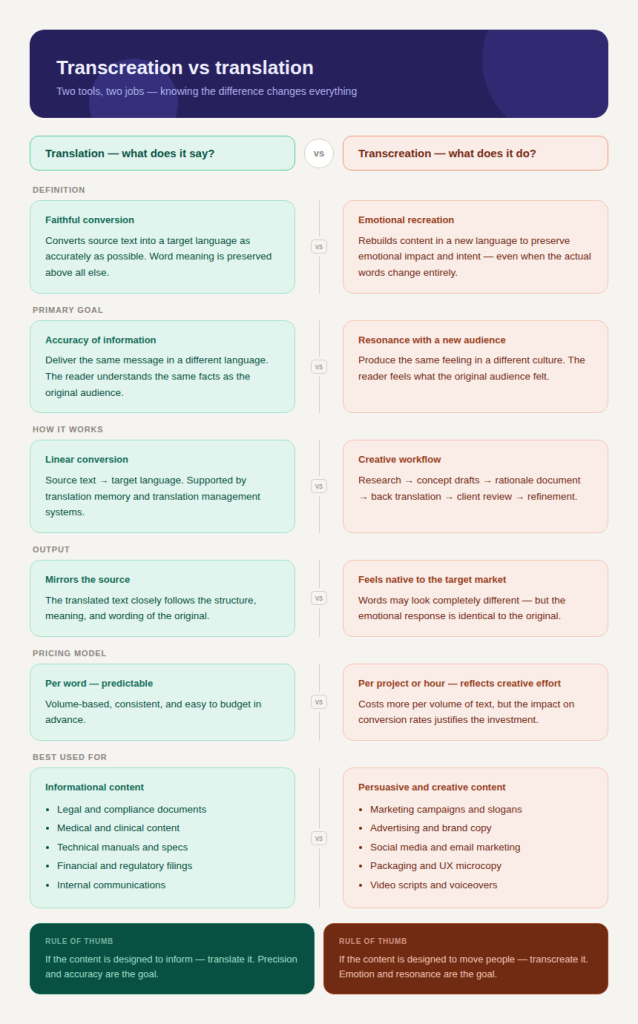
In terms of process, translation follows a linear path from source text to target language, supported by tools like translation memory and translation management systems. Transcreation involves research, creative development, multiple drafts, and rationale documentation — a creative workflow rather than a conversion process.
In terms of output, a good translation produces a faithful rendering of the original text. Transcreation produces content that may differ significantly in wording from the source text but matches in emotional resonance and persuasive effect — content that feels native to its new audience.
When it comes to cost, translation is typically priced per word, making costs relatively predictable. Transcreation is priced per project or per hour, reflecting the creative labor involved, and generally costs more than translation for equivalent volumes of text. In terms of timeframe, translation can often be completed quickly depending on volume, while transcreation requires more time for research, conceptualisation, and revision.
Why One Is Not “Better” Than the Other — They Serve Different Purposes
It is important to resist the temptation to frame transcreation as the premium, superior option and traditional translation as the basic fallback. These are two different tools designed for two different jobs, and using the wrong one — in either direction — creates problems.
Using translation where you need to transcreate produces flat, culturally tone-deaf creative content that fails to connect with the target audience. But using transcreation where translation is needed introduces unnecessary risk and cost. Nobody wants a transcreator taking creative liberties with a legal contract or a medical dosage instruction. In those contexts, precision is not just preferable — it is mandatory.
Understanding what’s the difference between transcreation and translation in terms of purpose — and then matching that purpose to your content — is the real skill. The rest of this article is designed to help you do exactly that.
We have created a comparison table to illustrate the key differences between Transcreation and Translation services as below
When Should You Use Translation Services?
Technical and Legal Documents
Any content where accuracy is the non-negotiable priority belongs in the translation category. Legal documents — contracts, terms and conditions, compliance documentation, court records — must convey exactly what the original text says. A verbatim legal translation services that captures every nuance of legal meaning is essential here. A creative interpretation of a contractual clause is not just unhelpful — it is potentially legally dangerous.
The same principle applies to technical documentation: user manuals, engineering specifications, software documentation, and safety guidelines all require precise, faithful translation. Readers of these documents need information, not inspiration. The goal of translation in this context is clarity and accuracy, full stop.
Medical and Scientific Content
Medical and scientific content sits firmly in the translation camp for similar reasons. Medical translation services involve patient information leaflets, clinical trial documentation, diagnostic reports, research papers, and pharmaceutical labeling all carry a responsibility for accuracy that cannot be compromised for the sake of creative adaptation.
In healthcare contexts, a mistranslated piece of original text can directly harm patients. In scientific publishing, accuracy is the fundamental standard by which all content is judged. These are precisely the situations where a translator’s expertise in linguistic precision and terminology is the most valuable asset — and where you absolutely do not need transcreation.
Internal Business Communications
When a company needs to share internal policies, HR documentation, training materials, operational procedures, or executive communications with employees in different countries, business translation services usually the appropriate choice. The goal is to ensure every employee receives the same original message, understands the same expectations, and operates from the same knowledge base.
Internal communications rarely need to be emotionally compelling in the way that marketing materials do. They need to be clear, consistent, and accurate — all of which translation handles well without the added cost and complexity of transcreation.
Financial Reports and Regulatory Filings
Annual reports, earnings statements, regulatory submissions, and investor communications require financial translation services. These documents are often subject to legal review and must meet strict standards of accuracy across all language versions. Even small discrepancies between the original text and the translation can create compliance issues or erode investor confidence.
Factual Product Descriptions and Manuals
For e-commerce businesses, accurate product descriptions — dimensions, materials, care instructions, technical specifications — need translation rather than transcreation. Customers making purchasing decisions based on this information need facts, not creative flair. The same applies to instruction manuals, assembly guides, and warranty documents. A literal document translation services that faithfully conveys the technical content of the source text is exactly what these materials require.
When Should You Use Transcreation Services?
Marketing Campaigns and Advertising Copy
This is the heartland of marketing transcreation. Advertising transcreation exists because marketing campaigns are designed to move people emotionally — to make them laugh, feel inspired, feel understood, feel desire. These emotional triggers are culturally specific. What feels witty and charming in one cultural context may feel cold or confusing in another.
When a marketing campaign is being adapted for a new market, transcreation ensures that it achieves in the target language what it achieved at home. The creative strategy remains intact while the execution is rebuilt to resonate with a new audience. This is why marketing translation that relies on verbatim translation of campaign copy so often fails — and why the best global brands invest in proper advertising transcreation.
Brand Taglines and Slogans
If there is one content type that almost always requires transcreation, it is the brand slogan. Taglines are among the most challenging content to carry across languages because they are typically compressed, rhythmically crafted, and deeply tied to cultural references and associations.
A three-word slogan that works brilliantly in English may be completely ineffective — or even awkward — when you translate it word for word into Japanese or Portuguese. If you need to transcreate a slogan for a new market, giving the transcreator creative freedom to find an equivalent in the target language — one that achieves the same emotional impact even if the words are entirely different — is essential. Some of the world’s most famous global slogans are, in fact, transcreated rather than translated.
Social Media Content and Influencer Campaigns
Social media content is defined by its informality, cultural immediacy, and reliance on current trends, humor, and local slang. Translating social media posts word for word almost always produces content that sounds slightly off — just formal enough or slightly out of touch to signal to native speakers that it wasn’t written by one of them.
Marketing transcreation allows social media content to feel native and current, using expressions, references, and tone that genuinely reflect how people communicate in the target language right now. When you want your brand’s social presence to resonate with a new audience as authentically as it does at home, transcreation is the right tool.
Video Scripts and Voiceovers
Video content that will be dubbed or re-voiced for different markets needs transcreation. Beyond the need for cultural resonance with the target audience, there are practical considerations: the transcreated script must fit the timing of the video, match lip movements where necessary, and work within the rhythm and pacing of the original production. This requires creative skill and cultural and linguistic expertise that goes well beyond a literal translation of the original text.
Email Marketing and Sales Copy
Email marketing and sales copy are persuasion tools that require transcreation to be effective across different markets. Subject lines need to compel opens. Body copy needs to build desire and overcome objections. Calls to action need to create urgency. All of these persuasive mechanisms are culturally inflected, and what works in one language market may fall flat in another.
A transcreator working on email marketing isn’t just changing the language — they are rebuilding the persuasive architecture of the message for a new cultural context and target audience. The difference between a transcreated email campaign and a translated one can show up directly in conversion rates.
Packaging Copy and Point-of-Sale Materials
Packaging copy often combines product information with brand voice and emotional appeal. The factual elements — ingredients, weights, usage instructions — need accurate translation from the original text. But the brand voice elements — the headline on the front of the pack, the brand story, the product personality — may require transcreation to ensure they resonate with local shoppers in the target market.
App Store Descriptions and UX Microcopy
App store listings are marketing materials, and they need to compete for attention and downloads in their target language markets. A translated description that sounds corporate or slightly awkward will consistently underperform against native-sounding copy that has been properly transcreated. UX microcopy — button labels, onboarding messages, error notifications — also benefits from transcreation because tone of voice matters deeply in user experience design and directly affects how the brand is perceived.
Real-World Examples of Transcreation Done Right (and Wrong)
Famous Transcreation Wins: How Global Brands Adapted Their Message
Some of the world’s most recognisable brands have relied on transcreation to maintain their emotional impact across cultural contexts — and these transcreation examples demonstrate just how powerful the discipline can be when done well.
KFC’s famous slogan “Finger Lickin’ Good” is a well-known example of a phrase that required careful adaptation rather than direct translation across markets. A literal translation of the source text in some languages would have produced something nonsensical or distasteful, so local markets received transcreated versions that communicated the same enthusiasm and sensory delight through culturally appropriate expressions that truly resonate with each target audience.
Coca-Cola’s “Open Happiness” campaign was adapted with significant creative latitude across different markets, with local transcreators finding expressions of joy and connection that reflected regional values and communication styles, rather than simply translating the English source text word for word.
McDonald’s approach to its marketing and advertising across Asian markets demonstrates transcreation in action at scale. Rather than simply translating its Western campaigns, McDonald’s rebuilds its creative content using local cultural references, humor styles, and emotional triggers that resonate specifically with each market’s values — a clear illustration of why effective transcreation goes beyond what traditional translation can deliver.
Transcreation Failures: What Happens When You Translate Marketing Copy Literally
The cautionary transcreation examples are equally instructive — and they show exactly why word-for-word translation of creative content is such a risk.
The American Dairy Association’s “Got Milk?” campaign, one of the most successful in US advertising history, was infamously translated for Spanish-speaking markets as “Are You Lactating?” — a verbatim translation of the source text that captured none of the original’s playful energy and instead produced a phrase that was bizarre at best and offensive at worst to many in the target audience.
Pepsi’s “Come Alive With the Pepsi Generation” slogan was reportedly translated for the Chinese market in a way that communicated something closer to “Pepsi Brings Your Ancestors Back from the Dead” — a cultural misstep that arose directly from applying literal translation to content that desperately needed transcreation, and that no amount of media budget could overcome.
Airline and travel brands have a particularly checkered history with direct translation, with several major carriers accidentally producing slogans in new markets that referenced death, discomfort, or misfortune — precisely the associations an airline needs to avoid. In every case, the failure lay in treating marketing and advertising copy as a candidate for literal translation rather than transcreation.
Lessons Marketers and Brand Managers Can Take From These Cases
The lesson from both the wins and the failures is consistent: the emotional resonance and cultural intelligence that make creative content effective in one market are almost never transferable through word-for-word translation alone.
The brands that succeed globally treat their creative assets as templates to be rebuilt for each target audience rather than documents to be translated. They invest in local cultural expertise. They give their language professionals creative freedom. And they measure success not by how closely the transcreated version mirrors the original text, but by how effectively it achieves the original message’s objectives in the new market. The key differences between the brands that thrive globally and those that stumble often come down to this single decision: translate or transcreate.
The Transcreation Process: What to Expect Step by Step
Step 1 — The Creative Brief: Why It’s the Foundation of Good Transcreation
Every successful transcreation process begins with a thorough creative brief. Unlike translation, where the source text largely speaks for itself, transcreation requires the language professional to deeply understand the strategic intent behind the content before any creative work begins.
A good transcreation creative brief covers the campaign or content objectives, the target audience profile in the new market, the desired emotional response, the brand’s tone of voice and personality guidelines, any cultural context or sensitivities to be aware of, examples of competitor content in the target market, and any specific elements of the source text that must be preserved versus those that can be freely adapted.
The quality of the creative brief directly determines the quality of the transcreation. Clients who invest time in thorough briefing consistently receive better transcreated content and need fewer revision rounds. This is one of the most important things you can do to support effective transcreation.
Step 2 — Cultural and Linguistic Research
Before putting pen to paper, an experienced transcreator spends time researching the target market. This includes understanding current cultural trends, local humor styles, current events that might affect how certain words or phrases land with the target audience, regulatory considerations for the industry, and the specific ways the target audience communicates in informal versus formal contexts.
This research phase is what truly separates transcreation from translation. It is invisible to the client but essential to the output. The cultural and linguistic intelligence gathered here is what allows the transcreator to make creative choices that genuinely resonate rather than simply making educated guesses.
Step 3 — Concept Development and Multiple Drafts
With the creative brief absorbed and the research done, the transcreator begins creating — usually developing several conceptual approaches to the content before settling on the strongest direction. This is the phase where creativity and cultural expertise combine to produce something that genuinely works in the target language.
For a slogan, this might mean generating ten to twenty options before presenting three to five strong candidates to the client. For longer content like a video script or a campaign brochure, it might mean drafting the piece in two or three different tonal approaches before recommending the most effective one for the target audience.
This is also the phase where the transcreator’s copywriting skills matter as much as their linguistic ability. The goal is not just to find something that works grammatically — it is to find something that genuinely compels the target audience to feel and act.
Step 4 — Back Translation and Rationale Review
One of the distinctive features of the professional transcreation process is the rationale document, which typically includes a back translation. Because the transcreated content may look quite different from the original text, clients need a way to understand and evaluate the creative choices that were made.
A back translation provides a literal translation of the transcreated content into the source language, so the client can see what it actually says — alongside an explanation of why each creative decision was made and how it serves the original message and campaign objectives. This document is what allows clients who don’t speak the target language to meaningfully evaluate the transcreation and provide useful feedback, rather than simply accepting or rejecting transcreated work they cannot read.
Step 5 — Client Feedback and Refinement
Transcreation is inherently collaborative, and revision rounds are a normal and expected part of the workflow. Client feedback at this stage should be framed in terms of whether the creative choices are achieving the desired emotional response — “this feels too formal for our brand’s tone of voice” or “the humor here doesn’t feel right for this target audience” — rather than comparing the transcreation word for word to the source text.
Experienced transcreators welcome specific, strategic feedback and use it to refine their work. The goal of this phase is alignment between the client’s brand vision and the transcreator’s cultural and creative expertise.
Step 6 — Final Approval and Delivery
Once the client is satisfied that the transcreated content achieves the campaign objectives in the target language, the work moves to final approval and delivery. Depending on the project, delivery might include the final copy file, the rationale document with back translation, notes on any remaining cultural context considerations for the client’s local team, and recommendations for adaptation of visual assets where relevant.
Some transcreation projects also include a local market review stage, where a native speaker from the target market provides a final check on cultural resonance before the content goes live — an additional quality step that can be worth the investment for high-stakes marketing and advertising campaigns.
What Skills Does a Transcreator Need?
Copywriting Ability vs. Translation Fluency
Transcreation sits at the intersection of two distinct skill sets, and the best transcreators possess both in genuine depth. Translation fluency — the ability to move expertly between two languages — is a necessary baseline. Without it, the transcreator cannot accurately absorb the original text or produce language that is natural and sophisticated in the target language.
But translation fluency alone does not make someone capable of effective transcreation. The other essential skill is copywriting: the capacity to write content that is genuinely persuasive, emotionally compelling, and creatively distinctive in the target language. Many professional translators are brilliant linguists but would not describe themselves as copywriters — and that distinction matters enormously when the work is a marketing campaign rather than a technical document.
Deep Cultural Knowledge and Local Market Awareness
Language and cultural context are inseparable, and a transcreator working in a target language must be immersed in the living culture of that language’s speakers — not just its formal linguistic rules. This means understanding current humor, contemporary cultural references, social values, generational differences in communication style, taboos, and the specific ways that brands in that market typically speak to their target audience.
A linguist who learned a language academically but does not live within its culture may produce grammatically correct transcreation that still misses the cultural mark entirely. This is why most transcreators work into their native language and are embedded in the target market — their cultural intelligence is as important as their linguistic skill.
Brand Voice Sensitivity and Emotional Intelligence
Every brand has a tone of voice — a distinct personality that is expressed through word choice, rhythm, and the kinds of humor or seriousness it employs. A transcreator must be able to absorb a brand’s tone of voice from its existing marketing materials and then express that same personality naturally in the target language and cultural context.
This requires a form of emotional intelligence: the ability to perceive the emotional resonance that a piece of content is designed to create and then rebuild that feeling using different linguistic and cultural materials. It is a sophisticated skill that distinguishes excellent transcreators from adequate ones — and it is why the best transcreation feels like it was written by someone who truly understands the brand.
Why Bilingual Doesn’t Automatically Mean Qualified to Transcreate
One of the most common and costly mistakes that businesses make is assuming that any bilingual employee or contact can handle transcreation. Being fluent in two languages is a genuine asset, but it does not automatically confer the copywriting skills, marketing knowledge, or deep cultural and linguistic expertise that effective transcreation requires.
Asking a bilingual team member to transcreate your marketing campaign is a bit like asking someone who speaks two languages to design your logo because they own a computer. The raw tool — language ability — is present, but the specialist skills required to use it professionally are not. When you need transcreation done well, you need a professional transcreator — not just a translator who also happens to speak the target language.
How Much Does Transcreation Cost — and Why?
Why Transcreation Is Priced Differently From Translation
Translation is typically priced per word because the volume of words in a document is a reasonable proxy for the work required. Transcreation cannot be priced this way because word count is not a meaningful measure of the creative effort involved in producing content that truly resonates with a target audience.
A three-word slogan that requires a full day of cultural research, creative development, multiple concept versions, and a rationale document with back translation represents far more labor than three words would suggest. Conversely, a longer piece of marketing copy that lends itself naturally to the target culture might come together relatively quickly once the research is done.
For this reason, transcreation is almost always priced by the project or by the hour, reflecting the actual creative and intellectual labor involved rather than the surface volume of the original text.
Hourly vs. Project-Based vs. Per-Word Pricing Models
Most transcreation professionals work on one of two pricing models. Project-based pricing is quoted at the outset based on the scope of the work, the languages involved, the complexity of the creative task, and the number of revision rounds included. This gives clients budget certainty and works well when the scope of the transcreation process is clearly defined.
Hourly pricing is used by some transcreators, particularly for ongoing relationships or projects where the scope is difficult to define in advance. This model gives clients flexibility but makes budgeting less predictable.
Some language services providers still list per-word rates for transcreation, but these should be understood as approximations — the actual cost will reflect the creative complexity of the project and the cultural context involved rather than pure word count.
Factors That Affect Cost: Language Pair, Industry, Volume, and Turnaround
Several variables influence the cost of a transcreation project. The language pair matters: transcreation into languages with smaller professional communities or into culturally distant new markets typically costs more than transcreation into widely spoken languages with large professional pools.
The industry matters too. Highly specialised markets — luxury goods, financial services, pharmaceuticals — require transcreators with both creative skill and domain expertise, and that combination commands a premium. The volume and complexity of the content, the number of revision rounds expected as part of the workflow, and the turnaround time required all factor into the final price.
How to Budget for a Transcreation Project
For businesses budgeting their first transcreation project, it helps to think in terms of creative services rates rather than translation rates from a traditional translation or language services provider. A reasonable benchmark for professional transcreation from an experienced practitioner is broadly comparable to hiring a senior freelance copywriter in the target market — because that is, in practical terms, what the role involves.
Getting quotes from two or three experienced transcreators and asking each to provide a detailed scope of what is included in their transcreation service will give you a realistic picture of market rates for your specific project.
How to Brief a Transcreator for the Best Results
What Information to Include in a Creative Brief
A thorough creative brief is the single most impactful thing a client can provide to a transcreator. At minimum, it should include a clear description of the campaign or content objectives, the target audience profile for the new market, the desired emotional response or call to action, the brand’s tone of voice guidelines, and any mandatory elements that must appear in the transcreated version.
The more context a transcreator has about why the original text was created the way it was — and what emotional impact it is designed to have — the better equipped they are to make smart creative decisions in the target language.
How to Share Your Brand Guidelines and Tone of Voice
Brand guidelines, tone of voice documents, and examples of existing marketing materials in the source language are all invaluable reference materials for a transcreator. If your brand has a defined personality — playful, authoritative, warm, aspirational — these materials help the transcreator calibrate their creative choices to ensure that the transcreated content feels authentically on-brand.
Where brand guidelines don’t exist in formal document form, even a selection of existing marketing and advertising materials that you feel represent the brand well can serve a similar purpose.
Why Providing Context Is More Important Than Providing Word Counts
Many clients brief transcreation projects the same way they brief translation services — by sharing the source text and specifying the word count. For transcreation, this approach misses the most important information.
A transcreator who knows the word count of your slogan but doesn’t know who the target audience is, what emotional response the content is designed to create, or what the broader campaign is about is working with one hand tied behind their back. Invest the time in providing meaningful context about the cultural context of the original text, and you will receive meaningfully better creative work in return.
Red Flags to Watch Out for When Hiring a Transcreator
When evaluating transcreators or transcreation services, watch for a few warning signs. A professional who doesn’t ask for a creative brief before starting work may not truly understand what the transcreation process requires. A provider who quotes purely per word may be planning to approach the work as traditional translation rather than transcreation. A freelancer or agency that doesn’t offer a rationale document with back translation as part of their deliverables may not be running a genuine transcreation workflow.
Equally, be wary of anyone who promises a very fast turnaround on creative content — speed is rarely compatible with the research and conceptual development that effective transcreation requires. If someone can turn around your marketing transcreation in an hour, they are almost certainly translating, not transcreating.
Industries That Rely on Transcreation Services the Most
Advertising and Marketing Agencies
Advertising agencies working with global clients are among the heaviest users of transcreation services. When a campaign concept needs to travel across multiple markets — each with its own language, humor, values, and communication norms — advertising transcreation is the mechanism that allows it to do so without losing its creative power and emotional impact.
Many large agencies have in-house transcreation teams or maintain dedicated relationships with specialist transcreation service providers for their key target markets.
Entertainment, Film, and Gaming
The entertainment industry relies on transcreation extensively. Film subtitles and dubbing scripts, video game localization, streaming content descriptions, and entertainment marketing and advertising all require the kind of creative cultural adaptation that transcreation provides.
Video game localization in particular has become a sophisticated transcreation discipline, with major publishers investing significantly in culturally authentic adaptations that go far beyond simple translation of game text — ensuring the game’s tone of voice, humor, and cultural references resonate with each new audience.
Fashion and Luxury Goods
Luxury brands live or die by their ability to communicate aspiration, exclusivity, and desire — and these qualities are expressed through language that is precisely calibrated to resonate with affluent consumers in each target market. A brand’s marketing copy that sounds even slightly awkward or generic immediately undermines the very qualities it is trying to project.
Fashion and luxury brands are among the most demanding transcreation clients, and rightly so. The precision required to maintain brand voice and luxury positioning across multiple languages while ensuring cultural authenticity in each target market is considerable — and it is why effective transcreation is so central to global luxury brand strategy.
Healthcare and Pharma Marketing
While clinical and regulatory documentation in healthcare belongs firmly in the translation category, patient-facing marketing materials, disease awareness campaigns, and healthcare brand advertising require transcreation. These campaigns often deal with sensitive topics — mental health, chronic illness, preventive care — where cultural context is critical and emotional resonance directly affects how the target audience engages with the message.
E-Commerce and Retail Brands
E-commerce brands selling across multiple markets need their product pages, promotional campaigns, and brand communications to feel genuinely local to each target audience. The fastest-growing global e-commerce brands typically invest in transcreation for their highest-visibility content — homepages, category pages, promotional banners, and email marketing — while using translation services for product specifications and customer service content where a literal translation of the original text is perfectly appropriate.
Non-Profit and Cause-Driven Campaigns
Non-profit organisations running campaigns on social issues — public health, environmental awareness, humanitarian causes — need their messages to move people to action. Emotional impact is everything in cause-driven communication, and a directly translated campaign that doesn’t account for cultural context can feel tone-deaf or even counterproductive in a new market.
Transcreation gives non-profit campaigns the cultural and linguistic intelligence they need to inspire genuine engagement across language barriers — ensuring the original message doesn’t just reach a new audience but truly moves them.
How to Decide: A Quick Decision Framework
5 Questions to Ask Before Choosing Translation or Transcreation
When you are trying to decide which approach is the best fit for a specific piece of content, five key questions will guide you to the right answer.
First, is the primary goal of this content to inform or to persuade and emotionally engage the target audience? Information belongs to translation; persuasion and emotional engagement require transcreation.
Second, does this content rely on wordplay, humor, cultural references, or a specific tone of voice? If yes, it is a strong candidate for transcreation — a word-for-word translation of the source text will not capture these elements effectively.
Third, what are the consequences of the content failing to resonate emotionally with its target audience? High stakes of poor emotional connection — such as declining conversion rates or brand damage — push strongly toward transcreation.
Fourth, is this content public-facing and brand-representing? Public-facing brand content almost always benefits from transcreation. Internal and technical content typically does not.
Fifth, is this content culturally time-sensitive — for example, tied to a current trend or cultural moment in the target market? Content with strong cultural timeliness almost always needs transcreation to land effectively with a new audience.
A Simple Decision Flowchart to Guide Your Choice
You can think of the decision as a simple sequential filter to help you choose the right approach. Start by asking whether accuracy or emotional impact is the primary success metric for this content. If accuracy, choose translation. If emotional impact, ask whether the content is culturally specific in its references or emotional triggers. If not, a skilled translator may suffice. If yes, commission transcreation.
As a general rule of thumb: if you would hire a copywriter to create this content originally in English, you should hire a transcreator — not just a translator — to adapt it for another target language. The creative brief, tone of voice, and cultural context are just as important as the source text itself.
When to Use Both in the Same Project
Many real-world projects require both translation and transcreation applied to different elements of the same deliverable — and understanding this can help you allocate your language services budget more effectively.
A product brochure might need translation for the technical specifications from the original text and transcreation for the brand copy on the cover and inside pages. A website might need transcreation for homepage copy that needs to resonate and convert, alongside translated product descriptions for the catalog. An email campaign might use transcreation for the subject line and opening hook and translation for the factual body content.
Thinking of translation and transcreation not as competing options but as complementary tools that can be applied selectively across a single project gives you the most cost-effective and highest-impact approach to multilingual content creation.
WhizWordz Is a Your Trusted Partner for Brand Transcreation Services
WhizWordz is a trusted transcreation and brand localisation partner in Singapore, helping businesses confidently expand into new markets with messaging that truly resonates with every target audience.
Our approach goes beyond traditional translation and basic localisation.
We specialise in transcreation services — adapting your brand’s voice, tone, and message in a way that preserves the emotional impact of your original content while aligning with the cultural context, local preferences, and customs of each target market.
Rather than delivering word-for-word translation that falls flat across cultural and linguistic boundaries, our transcreation process rebuilds your brand messaging from the ground up — ensuring your slogans, marketing materials, and advertising copy don’t just translate, but genuinely connect and compel.
With experienced linguists, skilled transcreators, and deep expertise in cultural adaptation, WhizWordz combines creativity and cultural intelligence to support businesses in building an authentic and effective brand presence across different languages and markets.
Our rigorous quality control ensures every transcreated piece reflects your brand’s tone of voice while resonating naturally with its new audience.
Whether you are adapting your brand for regional expansion or scaling globally — through website localisation services or multimedia localisation services — WhizWordz ensures your brand doesn’t just enter new markets. It fits, connects, and grows within them.
Frequently Asked Questions (FAQs)
Q1. What is the simplest way to explain the difference between transcreation and translation?
A: Translation changes the language. Transcreation changes the experience.
A translator’s goal is to render the source text accurately in the target language — preserving meaning as faithfully as possible. A transcreator’s goal is to preserve the emotional impact and persuasive power of the original — even if the actual words end up looking completely different.
A simple test: a translated piece should read as near-identical in meaning to the source text. A transcreated piece may look very different in wording — but should produce an identical feeling in the reader. Translation focuses on what content says. Transcreation focuses on what content does.
Q2: Is transcreation only relevant for large global brands, or can smaller businesses benefit too?
A: Transcreation is valuable for businesses of any size — and smaller businesses often have the most to gain from getting it right the first time.
Large brands can afford to recover from a poorly received campaign. A small business making its first move into a new market typically gets one shot at a strong first impression. If the slogan sounds awkward or the copy fails to resonate, that window closes fast.
The key is being strategic. Prioritize transcreation for your highest-visibility, most brand-defining content — your homepage headline, core tagline, and key advertising copy — while using translation for product descriptions, FAQs, and operational content. This approach delivers emotional impact where it matters most without requiring a large budget.
Q3: Can machine translation or AI tools handle transcreation?
A: Not reliably — not without significant human creative input.
AI translation tools are impressive at producing accurate, natural-sounding translations for informational content. But transcreation requires something AI currently cannot deliver: a real-time, living understanding of cultural context, emotional nuance, and creative judgment.
Knowing what words feel like to a native speaker in a specific cultural moment — what associations they carry, what humor they suggest — is embodied knowledge that machine translation cannot replicate.
Where AI genuinely helps is as a creative assistant within a human-led transcreation workflow — generating initial drafts, supporting research, and assisting with back translation. But the creative and cultural judgment that determines whether transcreated content truly resonates remains firmly human work.
Q4: What languages can you provide for professional transcreation services?
A: WhizWordz’s professional brand transcreation services can handle a wide range of languages, providing comprehensive transcreation support for both general and marketing business collaterals are accurately transcreation by native linguists.
Typically, transcreation services will involve the following languages such as Simplified Chinese translation, Malay translation, Indonesian translation, Japanese translation and Korean translation. And European language will include French translation, Spanish translation, Portuguese translation, German translation
Q5. How do I know if my content needs transcreation or if translation is enough?
A: Ask yourself one core question: is this content designed to inform, or to make someone feel something and take action?
Content designed to inform — technical documents, legal contracts, internal communications, product specifications — needs translation. Content designed to persuade, engage, or emotionally connect — marketing campaigns, slogans, advertising copy, email marketing — almost always needs transcreation.
Additional signals your content needs transcreation: it relies on wordplay, humor, or cultural references; it carries a distinctive brand tone of voice; it is public-facing and represents your brand to a new audience for the first time; or its success will be measured by engagement, conversion rates, or brand perception rather than simply information received.
Q6. How is transcreation priced compared to translation?
A: Translation is normally priced per word because word volume reasonably reflects the effort involved.
Transcreation cannot be priced this way — a three-word slogan requiring a full day of research, multiple creative drafts, a rationale document, and a back translation represents far more effort than three words would suggest.
For this reason, transcreation is priced by the project or by the hour, reflecting actual creative and intellectual labor rather than word count. Expect to pay more than you would for equivalent volumes of translated text.
A useful benchmark: think of transcreation costs as comparable to hiring a senior freelance copywriter in the target market — because that is essentially what you are doing. When you factor in the impact on conversion rates, brand perception, and campaign performance, effective transcreation almost always pays for itself.
Q7. Can one person be both a professional translator and a transcreator?
A: Yes — but it requires a specific and relatively rare combination of skills.
Both disciplines require deep fluency in at least two languages and strong cultural knowledge. But beyond that shared foundation, they diverge. Translation rewards precision, consistency, and faithfulness to the source text. Transcreation rewards creativity, cultural intuition, and copywriting ability — along with a comfort in departing from the source text when the emotional objectives demand it.
Some language professionals are genuinely skilled at both, and they are among the most valuable practitioners in the industry. But never assume that an excellent translator is automatically a qualified transcreator, or vice versa. Always ask about experience with your specific content type and ask to see relevant examples before committing.
Q8. Are there content types where transcreation should never be used?
A: Yes — and knowing these boundaries is just as important as knowing when transcreation is the right choice.
Transcreation involves creative interpretation and a willingness to depart from the literal source text. This makes it inappropriate for any content where accuracy is legally, medically, or operationally non-negotiable.
Legal documents, medical and clinical content, financial reports, regulatory filings, technical manuals, and scientific research all require precise, faithful translation — not creative adaptation. A transcreator taking liberties with a drug dosage instruction or a contractual clause could cause serious harm or legal liability.
The guiding principle is straightforward: if misrepresenting the content could cause harm or create liability, always use professional translation, never transcreation.