Beyond Subtitles: How AI Voice Cloning Is Changing How We Watch Content
Have you ever found yourself reading subtitles so intently during an international movie or video that you completely missed what was happening on screen? For decades, viewers faced a frustrating choice: either read text at the bottom of the screen or listen to a flat, mismatched voiceover that ruined the original actor’s performance.
That compromise is rapidly becoming a thing of the past.
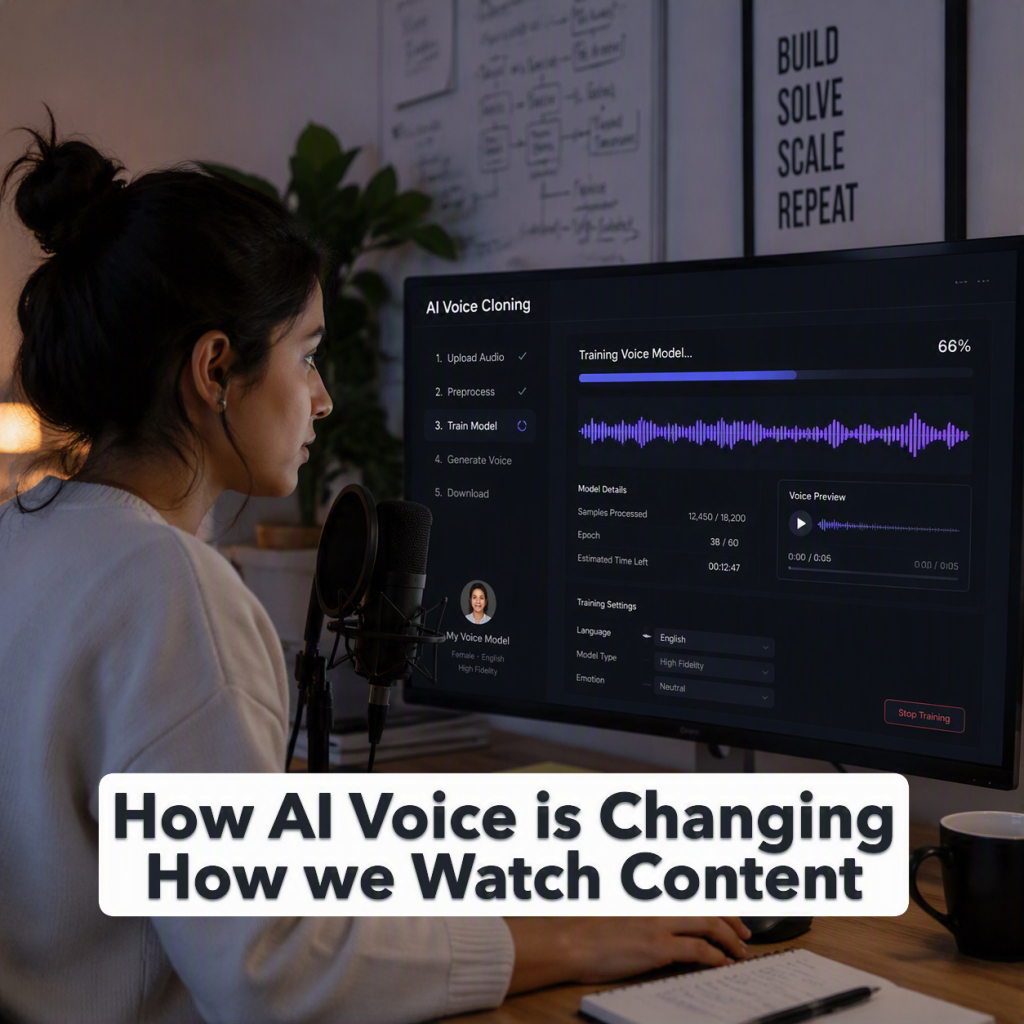
We have officially entered the era of multimodal AI translation. Advanced speech-to-speech models and voice cloning engines now allow creators, film studios, and global enterprises to localise video content instantly. Instead of replacing a speaker’s voice with a generic narrator, modern AI clones the speaker’s real vocal signature. It then translates their words into dozens of languages while preserving their exact pitch, emotional tone, and speaking cadence.
From global streaming platforms to online educators, AI voice cloning is redefining how media crosses borders. Here is a look at how this technology works, why its adoption is skyrocketing, and why human expertise remains vital to its success.
How Does AI Voice Cloning and Dubbing Work?
To understand why this shift is so significant, it helps to look under the hood of traditional dubbing. Historically, localising a video meant hiring native voice actors, booking recording studios, manually translating scripts, and attempting to match dialogue with lip movements. It was a slow, expensive process reserved mostly for high-budget Hollywood films or major television networks.
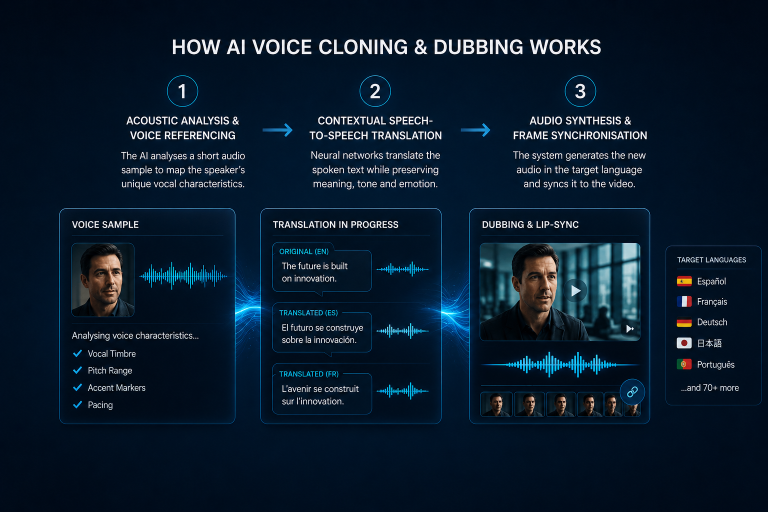
AI voice cloning replaces this fragmented workflow with a streamlined, intelligent pipeline. Rather than treating text and audio as separate steps, modern engines process speech contextually in three key stages:
1. Acoustic Analysis and Voice Referencing
The AI engine analyses a short audio sample of the original speaker. It maps out their unique vocal characteristics – including vocal timbre, pitch range, accent markers, and baseline pacing.
2. Contextual Speech-to-Speech Translation
Instead of performing a rigid word-for-word translation, neural networks translate the spoken text while considering sentence structure and cultural context. Advanced prosody engines ensure that emotional inflections, like excitement, urgency, or warmth, carry over smoothly into the target language.
3. Audio Synthesis and Frame Synchronisation
The system generates a new audio track using the cloned voice in the target language. Advanced platforms take this a step further by using automated lip-sync technology to subtly modify the speaker’s facial movements in the video, matching their lips to the new language’s phonemes.
The end result is localised video content where a speaker sounds like themselves in English, Hindi, Spanish, or Portuguese – without ever having spoken those languages.
Feature | Traditional Dubbing | AI-Powered Dubbing |
Production Time | Weeks to months | Hours to days |
Cost per Minute | $50 – $200+ | $2 – $30 |
Voice Consistency | Varies by region/actor | Identical voice model |
Scalability | Sequential per market | Simultaneous in 70+ languages |
Why Creators and Businesses Are Switching
The primary engine behind the adoption of AI voice cloning is a combination of unprecedented speed, lower production costs, and global audience engagement.
Dramatic Cost Reductions
Traditional studio dubbing often costs between $50 and $200 per minute of finished audio. For an e-learning platform with hundreds of course hours or an independent media studio, that price tag is often cost-prohibitive. AI-assisted dubbing reduces these expenses by 60% to 90%, bringing costs down to a fraction of traditional budgets.
Near-Instant Turnaround
Traditional dubbing workflows require scheduling actors, coordinating studio time, and managing multi-week editing cycles. AI platforms process translation, voice synthesis, and audio alignment simultaneously. Content that once took a month to localise can now be distributed globally in a matter of days or even hours.
Seamless Brand Consistency
When a global corporate brand or a popular video content creator expands into new international territories, trust is everything. Hearing a completely different, mismatched voice actor in every foreign market can weaken brand recognition. Voice cloning maintains a unified vocal identity across every localised campaign, ensuring that your spokesperson sounds like the exact same person worldwide.
Multi-Market Simultaneous Release
In today’s fast-moving digital ecosystem, releasing content weeks later in secondary markets means losing momentum. Modern AI workflows enable “day-and-date” global launches. A corporate product reveal, training module, or entertainment video can launch across English, Spanish, Bahasa Indonesia, and French markets at the exact same moment.
Empowering Viewers with Hearing Loss
Beyond global expansion, AI voice cloning offers a major leap forward for accessibility. Traditional video soundtracks often drown out dialogue with background music and effects, creating hurdles for hard-of-hearing viewers. AI dubbing generates clean, isolated audio tracks with consistent pitch, making speech far clearer and easier to understand.
Furthermore, voice cloning relies on precise millisecond timing, which dramatically improves closed captions and Subtitles for the Deaf and Hard-of-Hearing (SDH). Delivering crystal-clear audio alongside perfectly synchronised captions ensures global video content is genuinely inclusive for everyone.
Trust, Safety, and Voice Rights in the AI Era
As voice cloning capabilities become more accessible, they naturally raise important questions about copyright, ethical usage, and digital security. Unauthorised voice replication and identity theft are real concerns for performers, media studios, and corporate leadership alike.
As unauthorised synthetic audio spreads across digital platforms, performers and public figures are taking aggressive legal action to protect their vocal identities. A landmark example is the lawsuit filed in Tokyo District Court by renowned actor and voice actor Kenjiro Tsuda against social media platform TikTok. The suit targets nearly 200 videos that used unauthorised AI models to clone Tsuda’s signature deep, husky voice for commercial gain. Citing violations of publicity rights and unfair competition laws, Tsuda’s legal battle highlights a growing global demand for strict legal precedents, platform accountability, and clear boundaries surrounding voice ownership.
The translation and localisation industry has responded by establishing clear safety frameworks and ethical guardrails:
- Consent-Based Voice Licensing: Professional platforms mandate explicit digital consent from performers or spokespersons before cloning their vocal signature. Voice registries and licensing systems ensure talent is fairly compensated when their cloned voice is deployed across foreign markets.
- Audio Watermarking: Leading technology developers embed invisible, tamper-proof audio watermarks into synthesised speech. Watermarks allow platforms to verify whether an audio track was generated by an AI model, preventing deepfakes and misrepresentation.
- Enterprise Data Security: Top-tier B2B translation providers operate under strict zero-retention data privacy standards. Confidential corporate presentations, executive speeches, and legal media are processed securely without being used to train public-facing AI models.
Responsible AI usage ensures that speed and innovation never come at the expense of privacy or legal compliance.
The Human Touch: Why Technology Still Needs Cultural Oversight
While AI voice cloning solves the mechanical challenges of speed and scale, technology alone cannot master the deep nuances of human culture.
Language is far more than a collection of words; it carries regional humour, societal etiquette, historical context, and emotional nuance. An AI model might clone a voice flawlessly, but it can still miss crucial cultural context. For example, a direct translation of a casual marketing joke might sound confusing, or even offensive, when translated literally into another culture.
This is why the most successful global brands rely on a Hybrid Localisation Framework (often called “Human-in-the-Loop”):
- AI Efficiency: AI engines generate the initial transcription, voice clone, contextual translation, and audio alignment.
- Human Expertise: Professional native linguists and cultural consultants review the script to refine regional idioms, adjust formal tone, and verify brand messaging.
- Vocal Quality Assurance: Audio directors check the generated speech to ensure the emotional delivery feels authentic to local cultural expectations.
By combining the processing power of artificial intelligence with the empathy and judgment of professional translators, organisations achieve the ultimate global strategy: maximum speed without compromising cultural integrity.
Looking Ahead: The Future of Global Storytelling
We are moving toward a world where language barriers no longer limit our access to human stories, ideas, and entertainment. Subtitles will always have an important place, particularly for accessibility and language learning. However, AI voice cloning gives us something truly transformative: the ability to hear human ideas expressed in native voices across every corner of the globe.
Whether you are a creator expanding your international audience or an enterprise delivering seamless multi-region communications, the future of content consumption is native, expressive, and connected. Embracing these modern tools, supported by sound human strategy, ensures your message lands clearly everywhere it goes.
How Can WhizWordz Assist You in Professional Language Translation Services?
Expert Linguistic Matching: We assist you by leveraging our extensive pool of native translators across many language pairs, ensuring your content is handled by subject matter experts.
Seamless Communication: Our customer-first approach ensures a friendly, responsive support team that prioritises your specific needs and maintains clear communication throughout the process.
Comprehensive Project Solutions: Beyond standard translation, we provide a one-stop shop for your localisation needs, including copywriting, transcription, and typesetting.
Quality-Controlled Workflows: We use efficient processes designed to reduce resource wastage and ensure high-quality, prompt turnarounds for your projects.
Reliable Partnership: As a trusted partner and approved vendor for international institutions, we provide the peace of mind that comes with a proven track record of excellence.
Cost-Effective Results: We offer competitive, transparent pricing with no hidden costs, helping you manage your budget without sacrificing service quality.
Contact us here for urgent and non-obligation translation quote!