The Silent Crisis of Global Language Loss
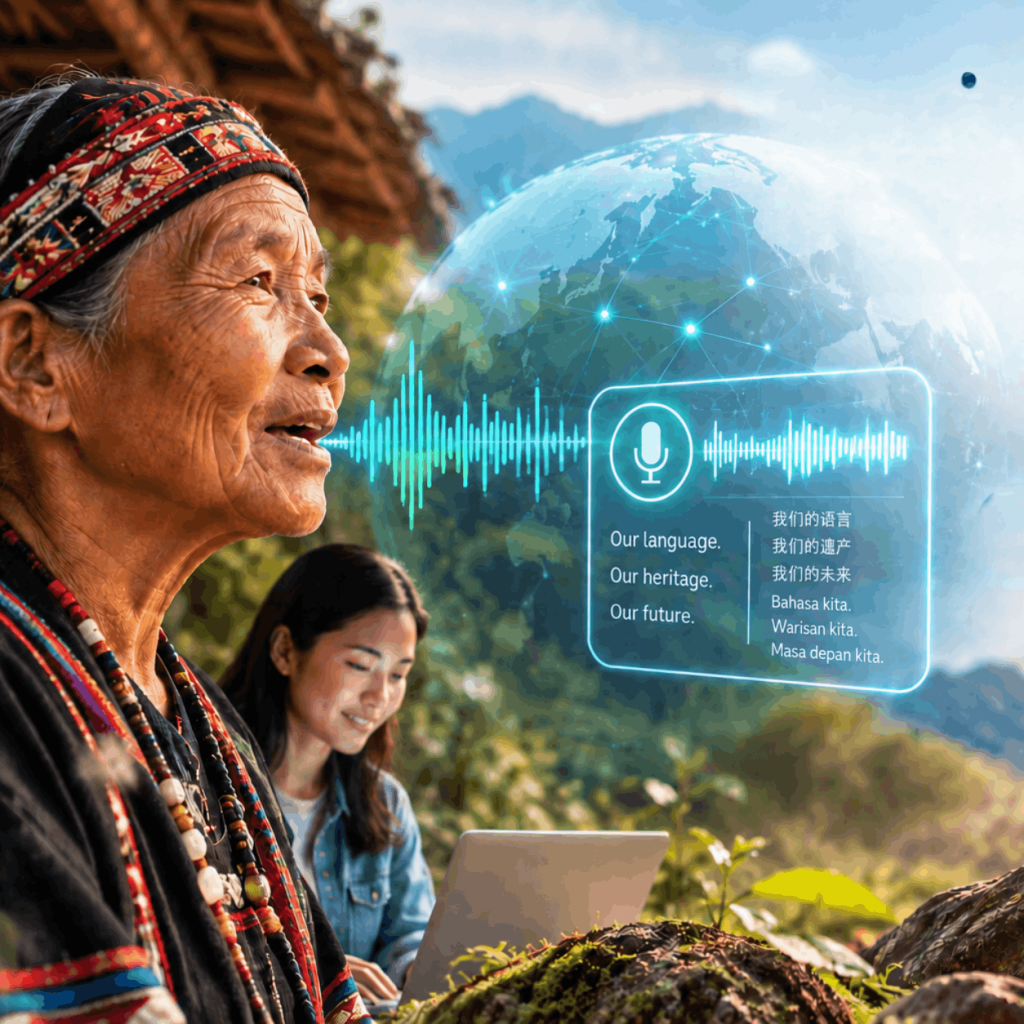
Around the world, human speech is growing quieter. Linguists estimate that humanity speaks roughly 7,000 active languages today. Yet, more than half are at risk of vanishing by the end of this century. Every two weeks, a language loses its last remaining fluent speaker, taking centuries of oral history, cultural wisdom, and a unique worldview along with it.
For decades, language preservation relied on painstaking manual work. Dedicated linguists spent years in the field recording interviews, building paper dictionaries, and transcribing folklore page by page. While invaluable, these traditional methods could not keep pace with the rapid rate of language loss.
When generative artificial intelligence transformed global communication, many hoped AI would instantly solve the language crisis. Imagine an AI that could translate, transcribe, and teach any language on Earth in real time. However, early attempts hit a major obstacle: the digital divide.
Popular AI models are trained on billions of pages scraped from the internet. They excel at English, Spanish, Mandarin, and French because those languages dominate the web. But for thousands of regional, indigenous, and minority dialects, digital content is scarce or non-existent. These are known in the translation industry as “low-resource languages”.
Without vast troves of digital text, standard AI models fail. They make severe grammatical errors, distort meanings, or invent words entirely. Fortunately, a new approach is turning the tide. By combining traditional linguistic rules with the advanced reasoning of Large Language Models (LLMs), hybrid AI systems are creating a reliable digital lifeline for the world’s most vulnerable voices.

Why Standard Generative AI Struggles with Data Scarcity
To understand why hybrid systems matter, it helps to see where standard AI falls short.
Modern generative AI operates through statistical prediction. When given a prompt, an LLM predicts the most likely next word based on patterns learned during its training. If a model reads billions of English sentences, it learns English grammar, slang, and context naturally.
When applied to low-resource languages, this statistical engine breaks down. Lacking sufficient examples, the model begins to guess. In AI research, this guessing is called “hallucination”.
For low-resource languages, hallucinations lead to three major issues:
- Semantic Drift: The AI distorts the original meaning of a sentence, replacing cultural nuances with literal or incorrect translations.
- Grammatical Collapse: Languages with complex internal structures, such as agglutinative languages that combine multiple word parts into single words, end up mangled into unnatural word-by-word translations.
- Dominant Language Bias: When unsure, an LLM defaults to the sentence structure or vocabulary of a dominant language like English, stripping away the unique identity of the minority dialect.
Relying solely on standard LLMs for language preservation risks doing more harm than good. A translation tool that generates false grammar or incorrect vocabulary can misinform language learners and distort historical records. Language preservation demands absolute accuracy. That demand has driven the creation of hybrid LLM frameworks.
The Power of Hybrid LLMs: Logic Meets Learning
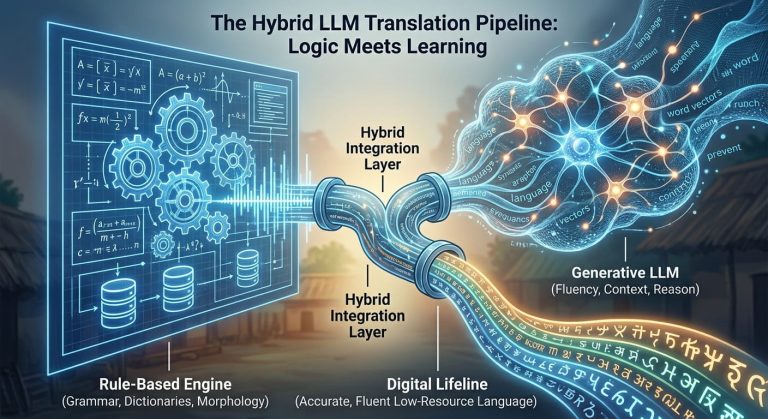
Instead of forcing a generative AI to guess, a hybrid LLM framework combines two distinct branches of computer science: symbolic (rule-based) AI and neural (generative) AI.
Think of a hybrid system as a construction team working on a building. The rule-based engine acts as the structural architect, providing exact blueprints and solid foundations. The generative LLM acts as the interior decorator, bringing natural flow, tone, and readability to the final output.
Here is how a typical hybrid translation pipeline functions in three steps:
1. Rule-Based Scaffolding
Before the AI generates a single word, text passes through a deterministic rule-based engine. This module uses human-verified bilingual dictionaries, morphological analysers, and strict grammatical lookup tables. If a word can be conjugated or broken down into root components using clear rules, the rule-based engine handles it with mathematical precision.
2. Context Retrieval (RAG)
Next, the system uses Retrieval-Augmented Generation (RAG). When translating a phrase, the system searches a curated database of verified community recordings and written texts. It pulls exact, culturally approved examples into the prompt memory, giving the AI concrete reference points instead of relying on internal memory.
3. LLM Post-Editing and Alignment
Finally, the generative LLM receives the structured data from the rule-based engine and the context from the retrieval system. Its job is not to invent the translation from scratch, but to refine sentence flow, adjust word order for natural reading, and ensure proper style.
By placing rigid boundaries around the generative model, hybrid systems drastically reduce hallucinations. The LLM performs what it does best, which is generating fluid text, while the rule-based foundation guarantees factual and structural accuracy.
Real-World Breakthroughs: From Theory to Practice
Hybrid AI is already helping real communities preserve their linguistic heritage across the globe.
Translating Complex Native Verbs
In North America, researchers developed hybrid models to process languages like Ojibwe, an Indigenous language known for its intricate verb structures. Traditional LLMs struggled because a single Ojibwe verb can carry the meaning of an entire English sentence through complex prefixes and suffixes.
By building a hybrid system that pairs a finite-state morphological analyser with an LLM, researchers achieved impressive accuracy. The rule-based module breaks down the complex verb mechanics, while the LLM converts the breakdown into fluent English – achieving translation speeds of 70 milliseconds per word while maintaining cultural intent.
Dictionary-Driven AI for Pacific Languages
In Taiwan, computational linguists applied hybrid RAG frameworks to preserve Paiwan and other Formosan languages. Facing limited digital texts, the team linked lightweight LLMs directly to structured digital lexicons. When a user inputs a phrase, the system looks up verified dictionary glosses first, forcing the LLM to build its sentence around authenticated human translations. The result is a tool that assists language learners without spreading inaccurate grammar.
Preserving Rare Writing Systems
In East Asia, researchers used hybrid AI tools like NüshuRescue to document Nüshu – a secret phonetic script historically used by women in Hunan, China. Using as few as 35 verified paired sentences, the hybrid system combined structural character mapping with LLM reasoning to translate texts and generate educational materials, proving that massive datasets are no longer mandatory for digital archiving.
Moving Beyond Text: Speech Recognition and Educational Tools
Language preservation involves far more than translating written words. Many low-resource languages are primarily oral, with rich traditions recorded in audio form rather than books.
Hybrid frameworks are expanding into automated speech recognition (ASR). Field recordings of elders often contain background noise, varied dialects, and older vocabulary. Standard speech-to-text tools fail under these conditions.
By pairing specialised acoustic models with hybrid text engines, researchers can transcribe hundreds of hours of archived audio interviews. This saves field linguists years of manual transcription work and converts recorded stories into searchable digital archives.
Once transcribed, these datasets feed into interactive learning platforms. Hybrid AI can power conversational chatbots that allow young community members to practice speaking their ancestral tongue. These tools offer safe, patient, and responsive practice environments, connecting youth back to their linguistic roots.
Ethics and Community Sovereignty
While hybrid AI offers extraordinary capabilities, technology alone cannot save a language. The true cornerstone of any preservation effort is community trust and data sovereignty.
In the past, indigenous communities often saw outside researchers collect their oral histories without clear permission or community benefit. In the era of artificial intelligence, those concerns are magnified. Native speakers rightly ask: Who owns our language data? Will tech companies profit from our sacred stories?
To succeed ethically, hybrid AI projects must follow clear community-led guidelines:
- Data Ownership: Communities must retain full legal ownership of their language archives, audio recordings, and translation models.
- Consent and Control: Local elders and native speakers must decide what information is shared publicly and what knowledge remains private.
- Human Validation: Native speakers must serve as the ultimate validators of AI outputs, ensuring cultural concepts are represented accurately and respectfully.
When technology respects community ownership, AI stops feeling like an external imposition and becomes an empowering tool for self-expression.
A Vibrant Digital Future for World Languages
Language extinction is not inevitable. The digital divide once threatened to erase thousands of regional dialects from the modern internet, but hybrid LLM architectures have reshaped what is possible.
By combining the structural truth of rule-based linguistics with the semantic power of modern AI, we can build accurate, trustworthy translation tools using a fraction of the data previously required. These systems lower the cost of preservation, accelerate transcription work, and put powerful educational tools directly into the hands of native communities.
As these hybrid models continue to evolve, they promise something vital: a digital world where modern technology does not flatten global culture into a monologue, but enriches it into a thriving, multilingual chorus.
How Can WhizWordz Assist You in Professional Language Translation Services?
Expert Linguistic Matching: We assist you by leveraging our extensive pool of native translators across many language pairs, ensuring your content is handled by subject matter experts.
Seamless Communication: Our customer-first approach ensures a friendly, responsive support team that prioritises your specific needs and maintains clear communication throughout the process.
Comprehensive Project Solutions: Beyond standard translation, we provide a one-stop shop for your localisation needs, including copywriting, transcription, and typesetting.
Quality-Controlled Workflows: We use efficient processes designed to reduce resource wastage and ensure high-quality, prompt turnarounds for your projects.
Reliable Partnership: As a trusted partner and approved vendor for international institutions, we provide the peace of mind that comes with a proven track record of excellence.
Cost-Effective Results: We offer competitive, transparent pricing with no hidden costs, helping you manage your budget without sacrificing service quality.
Contact us here for urgent and non-obligation translation quote!